Giant panda
From Wikipedia, the free encyclopedia
"Panda" redirects here. For other uses, see Panda (disambiguation).

| Giant panda | |
|---|---|
 |
|
| Giant panda at Ocean Park, Hong Kong | |
| Conservation status | |
Scientific classification  |
|
| Kingdom: | Animalia |
| Phylum: | Chordata |
| Clade: | Synapsida |
| Order: | Therapsida |
| Class: | Mammalia |
| Order: | Carnivora |
| Family: | Ursidae |
| Genus: | Ailuropoda |
| Species: | A. melanoleuca |
| Binomial name | |
| Ailuropoda melanoleuca (David, 1869) |
|
| Subspecies | |
 |
|
| Giant panda range | |
The giant panda lives in a few mountain ranges in central China, mainly in Sichuan province, but also in the Shaanxi and Gansu provinces.[7] As a result of farming, deforestation and other development, the panda has been driven out of the lowland areas where it once lived.
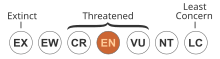
The panda is a conservation reliant endangered species.[8] A 2007 report shows 239 pandas living in captivity inside China and another 27 outside the country.[9] Wild population estimates vary; one estimate shows that there are about 1,590 individuals living in the wild,[9] while a 2006 study via DNA analysis estimated that this figure could be as high as 2,000 to 3,000.[10] Some reports also show that the number of pandas in the wild is on the rise.[11][12] However, the IUCN does not believe there is enough certainty yet to reclassify the species from Endangered to Vulnerable.[1]
While the dragon has often served as China's national emblem, internationally the panda appears at least as commonly. As such, it is becoming

No comments:
Post a Comment